
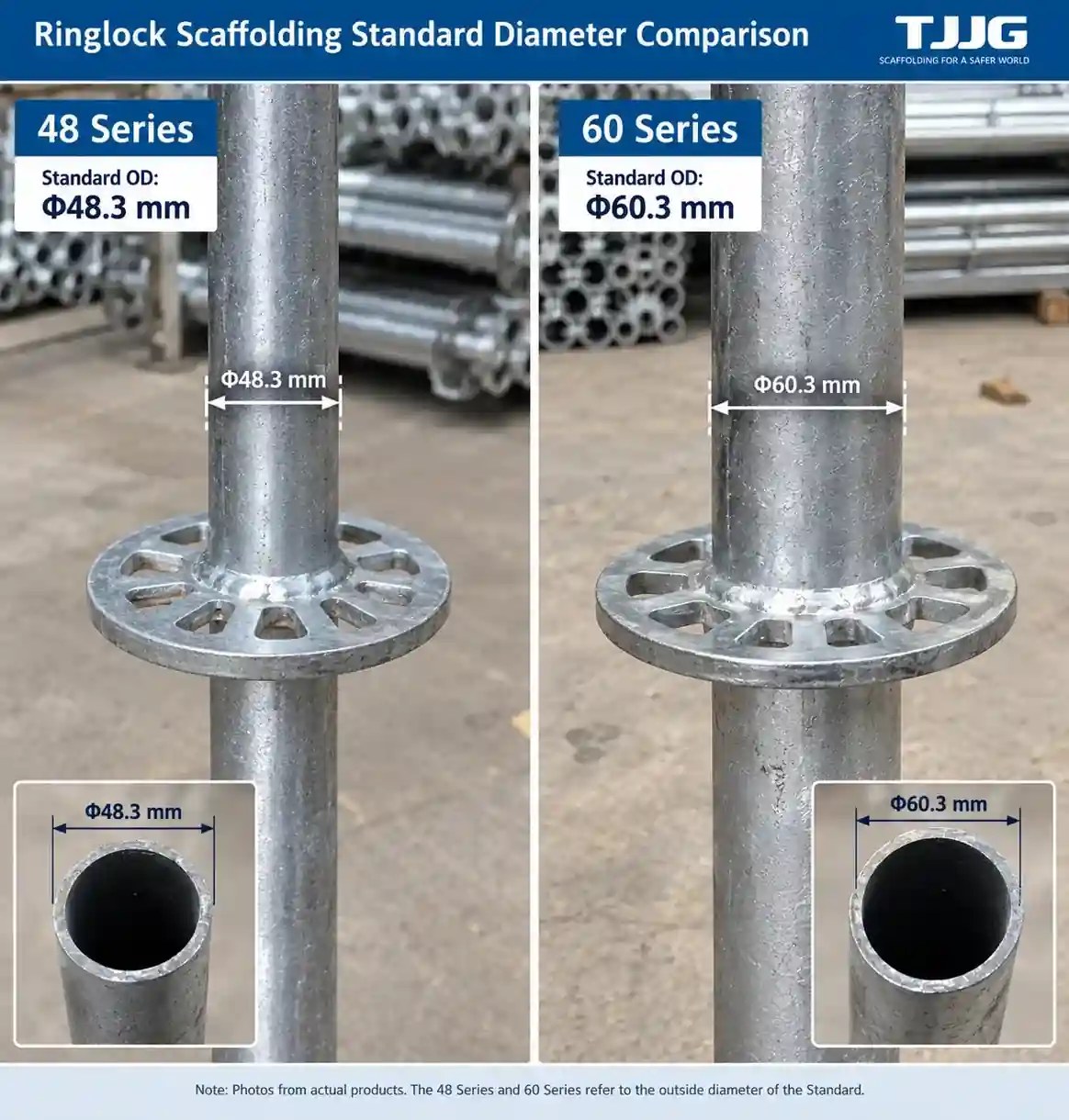
48 Series vs 60 Series Ringlock Scaffolding
48 Series and 60 Series Ringlock scaffolding are two different Ringlock system families.
The most obvious difference is the outside diameter of the vertical Standard. In TJJG’s current product data, the 48 Series Standard is Φ48.3 × 3.25 mm, while the 60 Series Standard is Φ60.3 × 3.25 mm.
However, the difference between the two systems should not be reduced to “small tube versus large tube.” Connection details and matching components also need to be confirmed before a system is ordered, expanded or used for replacement stock.
What Do 48 Series and 60 Series Mean?
The series name starts with the main vertical Standard.
| Item | 48 Series | 60 Series |
|---|---|---|
| Standard Outside Diameter | Φ48.3 mm | Φ60.3 mm |
| Current Standard Wall Thickness | 3.25 mm | 3.25 mm |
| Current Standard Material | Q355 | Q355 |
These values are based on TJJG’s current product specifications.
The Standard diameter is the starting point for identifying the system family, but a complete Ringlock scaffold also includes Ledgers, Diagonal Braces, Base Collars, Base Jacks, U-Head Jacks and other compatible accessories.
If the task is to identify an unknown existing scaffold rather than compare the two systems, see how to identify 48 Series and 60 Series Ringlock scaffolding.
48 Series Ringlock Scaffolding
The current TJJG 48 Series uses a Φ48.3 mm vertical Standard.
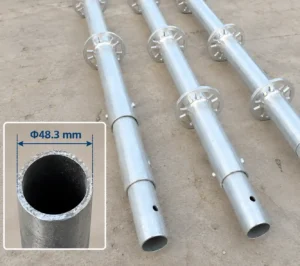
A complete 48 Series system may include:
- Standards;
- short or auxiliary Standards;
- Base Collars;
- Ledgers;
- Diagonal Braces;
- Adjustable Base Jacks;
- Adjustable U-Head Jacks;
- Steel Planks;
- Staircases;
- Side Brackets and other compatible accessories.
One common 48 Series configuration uses a sleeve-type Standard connection, but this should not be treated as a universal rule. Connection details can vary between manufacturers and markets.
60 Series Ringlock Scaffolding
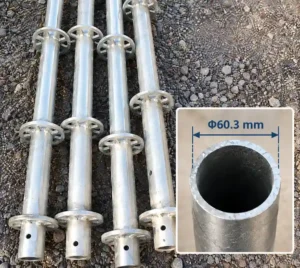
The current TJJG 60 Series uses a Φ60.3 × 3.25 mm vertical Standard.
One common 60 Series configuration uses a connecting spigot between vertical Standard sections.
As with the 48 Series, the actual connection arrangement should be confirmed from the product specification rather than assumed from the series name alone.
The 60 Series is also a complete component system rather than simply a larger vertical tube.
48 Series vs 60 Series: Basic Comparison
| Item | 48 Series | 60 Series |
|---|---|---|
| Standard OD in Current TJJG Data | Φ48.3 mm | Φ60.3 mm |
| Standard Wall Thickness in Current Data | 3.25 mm | 3.25 mm |
| Standard Material in Current Data | Q355 | Q355 |
| Typical Standard Connection Example | Sleeve-type connection | Connecting-spigot connection |
| Complete Matching System Required | Yes | Yes |
This table is for product comparison and identification. It is not a load-capacity table or structural design guide.
Is Standard Diameter the Only Difference?
No.
The Standard diameter is the most obvious visible difference, but buyers may also need to check:
- rosette geometry;
- Standard connection method;
- Ledger head geometry;
- Ledger lengths;
- Diagonal Brace connections;
- Base Collar dimensions;
- Base Jack dimensions;
- U-Head Jack dimensions;
- component weight;
- surface treatment;
- assembly fit.
This becomes especially important when a new order needs to connect with an existing Ringlock inventory.
Are the Ledgers the Same?
Do not decide this from the steel tube alone.
A Ledger used in two different systems may look similar while the Ledger head, effective length or connection geometry is different.
The actual product specification and connection details matter more than appearance.
If the order is for replacement components, see Ringlock replacement component compatibility.
Are the Diagonal Braces the Same?
The same principle applies to Diagonal Braces.
Brace compatibility can depend on:
- Brace length;
- end connection geometry;
- vertical bay dimensions;
- horizontal bay dimensions;
- the actual Ringlock node connection.
A similar tube does not prove that the Brace belongs to the same system.
What About Base Jacks and U-Head Jacks?
Adjustable Jacks should also be checked against the required system specification.
Relevant product details may include:
- screw diameter;
- wall thickness;
- overall screw length;
- base plate dimensions;
- U-Head dimensions;
- nut and thread configuration;
- fit with the surrounding components.
The total screw length should not be confused with the permitted site extension.
For component condition and inspection, see Ringlock Base Jack and U-Head Jack inspection.
Does 60 Series Always Mean Higher Load Capacity?
No responsible comparison should use the larger Standard diameter alone to assign one universal load value to the 60 Series.
The behaviour of an erected Ringlock support arrangement can also depend on:
- component specification;
- Standard length;
- effective support height;
- Ledger spacing;
- bracing arrangement;
- Base Jack and U-Head arrangement;
- connection condition;
- supporting surface;
- overall system geometry;
- the approved engineering design.
A generic online load table should not be used to choose between 48 Series and 60 Series unless it actually applies to the system being designed.
Is 60 Series Only for Shoring?
No simple rule such as “48 Series is for access scaffolding and 60 Series is for shoring” should be treated as universal.
Actual market practice and system configurations vary.
TJJG can supply both 48 Series and 60 Series components for confirmed requirements.
The system should be selected from the project design, existing inventory, BOQ or drawing rather than from the application name alone.
Can 48 Series and 60 Series Components Be Mixed?
Do not assume that two components can be mixed just because both are described as Ringlock.
System compatibility may depend on more than the Standard outside diameter.
The rosette, Ledger head, wedge, Standard connection, Brace end and adjustable components may all need to match.
For a detailed compatibility check, see how to check replacement Ringlock component compatibility.
48 Series or 60 Series: Which Should You Buy?
There is no single answer for every buyer.
For an existing scaffold fleet, the first question is normally:
Which system is already in use?
If a contractor already owns compatible Ringlock stock, expanding the same system may be more practical than buying components that cannot connect with the existing inventory.
For a new project, the selected series should follow the approved project requirement and component system.
For an importer or distributor, the system already used by customers in the target market can also matter.
New Complete System vs Replacement Order
The information needed for a new complete system is different from the information needed for replacement parts.
For a new project with an approved BOQ or drawing, the full Ringlock system can be prepared around one confirmed specification.
A replacement order needs more care because the new product must match equipment that is already in service.
If the existing series is unknown, first identify it from dimensions, connection details, photos and available documents.
See how to identify an existing 48 or 60 Series Ringlock system.
What Should Buyers Confirm Before Ordering?
Useful information includes:
- 48 Series or 60 Series;
- project application;
- component names;
- component lengths and sizes;
- quantity;
- surface treatment;
- BOQ;
- drawing where available;
- whether the order is a complete new system or replacement stock.
If the series is not known, send photos and measurements of the existing products instead of guessing.
What Information Helps with Replacement Orders?
For replacement Ringlock components, useful information may include:
- existing component photos;
- Standard outside diameter;
- component length;
- rosette dimensions;
- Ledger head details;
- wedge details;
- Standard connection method;
- existing drawing or specification;
- a sample component where necessary.
The goal is simple: avoid shipping a component that looks close in a catalogue but will not connect to the scaffold the customer already owns.
Where Can Buyers Review the Main Ringlock Components?
Standards, Ledgers, Braces, Base Collars, Jacks and other Ringlock components should be considered as a system rather than isolated products.
For the main product structure, see the Ringlock scaffolding system page.
FAQ
Frequently Asked Questions
Quick answers to common 48 Series and 60 Series Ringlock questions.
What is the main difference between 48 Series and 60 Series Ringlock?
The most obvious difference is the Standard outside diameter. TJJG’s current 48 Series Standard is Φ48.3 mm, while the 60 Series Standard is Φ60.3 mm.
Can 48 Series and 60 Series Ringlock components be mixed?
They should not be assumed to be interchangeable. Connection geometry, Standard joints, Ledger heads, Braces and other components need to be checked against the actual system specification.
Does a 60 Series Standard automatically mean higher load capacity?
No. Structural performance depends on the complete system configuration, component specification, support height, bracing, base and top adjustment, connection condition and approved engineering design.
What should I send if I do not know whether my system is 48 or 60 Series?
Send clear product photos, Standard outside diameter, component lengths, rosette details, Ledger head details, Standard connection details and any available drawing or specification.
Conclusion
The clearest difference between 48 Series and 60 Series Ringlock scaffolding is the Standard diameter: TJJG’s current product data uses Φ48.3 mm for 48 Series and Φ60.3 mm for 60 Series.
After that, check the rest of the system. Ledgers, Diagonal Braces, Standard connections, Base Collars and adjustable Jacks still need to match the required Ringlock configuration.
For a new project, start with the approved BOQ or drawing. For replacement stock, start with the system already standing in the customer’s yard or on site.
Need Help Confirming 48 or 60 Series?
If you are preparing a new Ringlock order or replacing components in an existing system, send the available dimensions, photos, BOQ or drawings. We can help review the product requirement before quotation.