
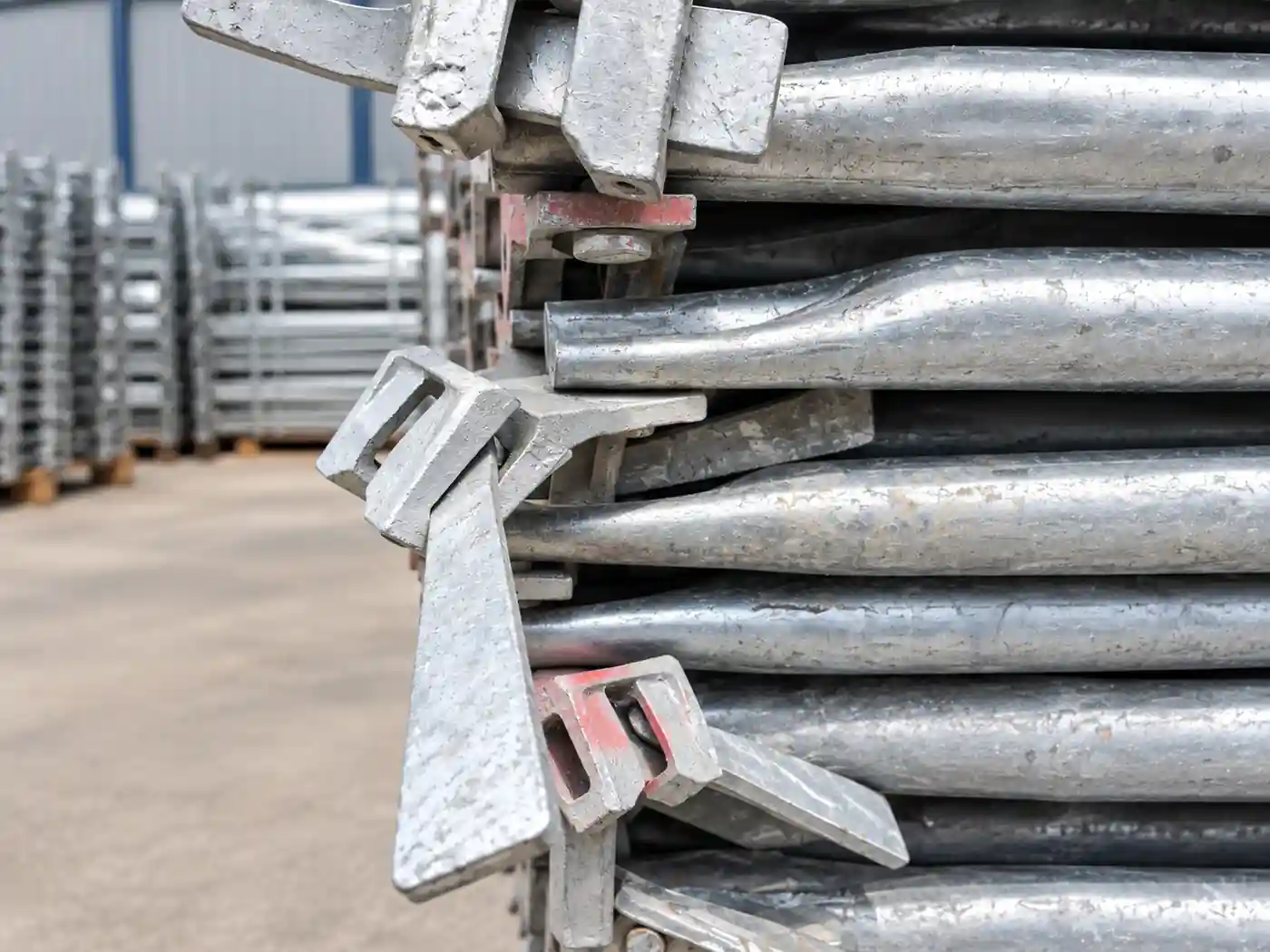
How to Perform a Ringlock Scaffolding Assembly Fit Check?
A Ringlock scaffolding assembly fit check is a practical quality-control step used when there is a need to confirm that specified components connect and work together normally.
A component can meet its individual dimensional requirements and still create an assembly problem because connection areas, mating parts or component condition affect the final fit.
For this reason, dimensional inspection and physical assembly checking answer different questions and may both be required during quality control.
What Is a Ringlock Assembly Fit Check?
A Ringlock assembly fit check is a practical test in which mating components are connected together to verify that the connection works normally.
The purpose is to check real system fit rather than only isolated product dimensions.
Depending on the components being inspected, the check may include:
- Standard-to-Standard connection;
- Ledger-to-Rosette connection;
- wedge locking;
- Diagonal Brace connection;
- Base Collar-to-Standard fit;
- Base Jack fit;
- U-Head Jack adjustment;
- obvious abnormal looseness after assembly.
These are the same basic connection areas that should be considered in a broader Ringlock scaffolding inspection checklist.
Why Is an Assembly Fit Check Necessary?
A Ringlock component can pass a basic dimensional inspection and still create a problem when connected to another part.
Possible reasons include:
- local deformation;
- damaged connection areas;
- obstructed openings;
- poor alignment;
- wear at mating surfaces;
- incorrect component matching;
- weld distortion near connection areas;
- abnormal looseness after locking.
This is why Ringlock component assembly should sometimes be tested physically instead of relying only on individual measurements.
When Should an Assembly Fit Check Be Performed?
An assembly fit check can be useful before shipment, during incoming inspection or whenever there is uncertainty about whether components connect correctly.
It is particularly useful when:
- components come from different production batches;
- used components are being inspected;
- connection damage is suspected;
- replacement parts are being reviewed;
- there is visible deformation near a connection area;
- a wedge or Ledger connection feels abnormally loose;
- measurements appear correct but assembly remains difficult.
The purpose is not to erect a complete scaffold during every product inspection. It is to test the relevant mating components where fit needs to be confirmed.
Check Standard-to-Standard Connection
Ringlock Standards are connected vertically through the specified connection arrangement, such as a connecting sleeve or spigot depending on the system.
During a Ringlock fit check, inspect whether the mating Standards connect normally.
Look for:
- obstructions preventing insertion;
- visible deformation around the connection area;
- damage around connection holes where applicable;
- poor alignment;
- abnormal looseness after connection.
A Standard should not be judged only by its overall length if the next Standard cannot connect correctly.
Check Ledger-to-Rosette Connection
The Ledger, Ledger head, wedge and rosette should be considered together during Ringlock connection inspection.
Check whether the Ledger head enters the intended rosette position correctly and whether the mating parts sit in their normal working position.
Potential issues can include:
- deformed Ledger heads;
- obstructed rosette openings;
- poor alignment;
- visible wear;
- difficulty engaging the connection;
- abnormal looseness after locking.
Detailed rosette, wedge and Ledger-head defect inspection is a separate specialist topic and should not be replaced by this general assembly test.
For that deeper inspection, see how to inspect Ringlock rosettes, wedges and Ledger connections.
Check Wedge Movement and Locking
The wedge should move normally and allow the connection to engage as intended.
During inspection, confirm whether:
- the wedge moves without obvious obstruction;
- the wedge can enter the connection correctly;
- the connection reaches its normal locked condition;
- abnormal looseness remains after full engagement.
If a connection stays loose after the wedge has been replaced, the wedge should not automatically be blamed.
The rosette opening, Ledger head, deformation, weld area and overall Ringlock system fit may also need to be checked.
Check Diagonal Brace Connection
A Diagonal Brace can look acceptable when inspected separately and still reveal a connection problem during assembly.
Check whether the brace end can connect normally to the required Ringlock node.
Pay attention to:
- bent brace ends;
- damaged connection parts;
- poor engagement;
- difficulty reaching the intended connection point;
- visible deformation of the brace tube.
Assembly testing is particularly useful when there is doubt about whether the brace shape or end connection has been affected by handling or previous use.
Check Base Collar-to-Standard Fit
The Base Collar forms part of the lower starting arrangement in a Ringlock system.
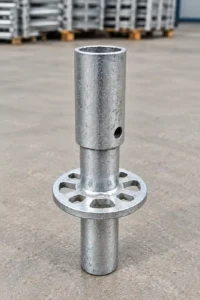
During a Ringlock assembly inspection, check whether the Base Collar and Standard connect normally according to the confirmed system.
The connection area should not be obstructed, visibly deformed or so loose that normal assembly becomes doubtful.
The purpose is simply to confirm functional fit between the specified parts.
Check Adjustable Base Jack Fit
Base Jacks should be inspected not only for dimensions but also for whether they fit and adjust normally within the required support arrangement.
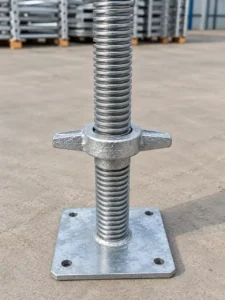
Typical functional checks can include:
- fit with the required lower component;
- straightness of the screw stem;
- normal nut movement;
- thread condition;
- obvious deformation.
The permitted extension during actual site use should not be determined from this fit test.
That belongs to the approved scaffold or shoring design.
For detailed inspection, see Ringlock Base Jack and U-Head Jack inspection.
Check U-Head Jack Adjustment
U-Head Jacks should also move and adjust normally.
Inspect the screw, thread, nut and U-Head plate condition while confirming that the component fits the intended system.
A visually acceptable U-Head Jack should still be set aside for further inspection if:
- the screw is bent;
- the nut cannot move normally;
- the thread is severely damaged;
- the U-Head plate is visibly deformed;
- the component cannot fit the required assembly correctly.
What Does Abnormal Looseness Mean?
Some connections naturally require clearance for assembly, so not every movement should automatically be described as a defect.
However, abnormal looseness after correct assembly deserves further inspection.
The cause may involve more than one component.
Possible areas to inspect include:
- rosette condition;
- Ledger head condition;
- wedge condition;
- component deformation;
- connection wear;
- weld distortion;
- incorrect component matching.
A universal looseness value should not be invented without an applicable drawing, specification or test requirement.
Why Dimensional Inspection Alone Is Not Enough
Dimensional inspection and assembly inspection answer different questions.
Dimensional inspection asks:
Does this component match the required size and specification?
Assembly fit inspection asks:
Do the required mating components actually connect and function correctly together?
Both checks can be important.
For the dimensional side, see Ringlock scaffolding dimensional inspection before shipment.
Assembly Fit Check vs Compatibility Check
These two topics are related but not identical.
An assembly fit check is a quality-control activity used to verify how specified mating components physically connect.
A compatibility check is broader. It may involve determining whether replacement components from another batch, supplier or existing system should be considered suitable for use together.
Physical fit alone does not prove full system compatibility.
For replacement-component questions, see Ringlock replacement component compatibility.
Should Components from Different Sources Be Tested Together?
When components come from different sources, an assembly test can reveal obvious physical fit problems.
However, passing a simple physical fit check should not automatically be interpreted as proof that different systems are fully interchangeable.
Dimensions, connection geometry, material specification and approved project requirements may also matter.
This is another reason to keep assembly QC and compatibility assessment as separate topics.
What Should Be Recorded During an Assembly Fit Check?
A practical inspection record can identify:
- components tested;
- Ringlock series;
- relevant product specification;
- connection being checked;
- whether normal engagement was achieved;
- whether abnormal looseness was observed;
- visible damage or deformation;
- items separated for further review.
The aim is to make the result traceable to the actual components tested.
When Should a Component Be Set Aside?
A component should be separated for further inspection when the assembly check reveals uncertainty about its condition.
Examples include:
- a connection that cannot engage normally;
- a wedge that cannot lock correctly;
- abnormal looseness after correct assembly;
- visible connection deformation;
- a bent brace end;
- damaged threads;
- obstructions at mating surfaces;
- poor fit between specified components.
Final acceptance should follow the confirmed product requirement, drawing, inspection criteria and actual findings rather than a generic online rule.
What Can a Supplier Check Before Shipment?
Before shipment, a Ringlock supplier can perform assembly checks on relevant component combinations where required by the confirmed order or quality-control process.
For TJJG supply, this can be combined with dimensional, welding, galvanizing, weight, quantity and packing checks according to the confirmed order requirements.
This product-level assembly inspection does not replace final inspection of the completed scaffold or shoring structure after erection.
Conclusion
A Ringlock scaffolding assembly fit check helps identify problems that isolated measurements may miss.
Standards, Ledgers, wedges, rosettes, Braces, Base Collars and adjustable Jacks should be checked as mating components where functional fit needs to be confirmed.
The key principle is that a component should not be judged only by how it looks or by one dimensional measurement.
If the required parts cannot connect, lock or adjust normally, the issue should be investigated before the component is accepted for shipment or use.