
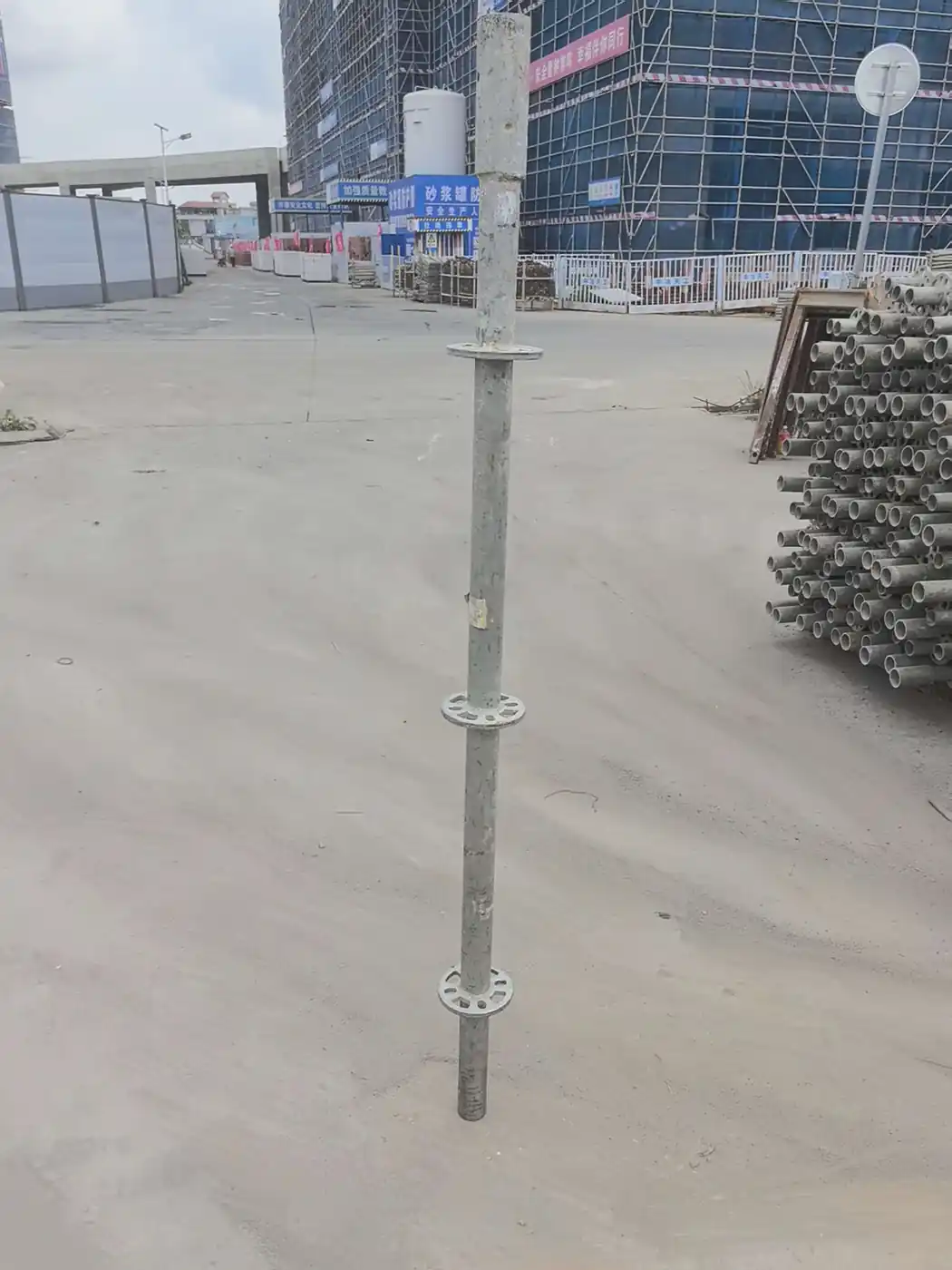
How to Identify 48 Series and 60 Series Ringlock Scaffolding?
If you have an existing Ringlock scaffold but do not know whether it is 48 Series or 60 Series, start with the vertical Standard.
In TJJG’s current product data, the 48 Series Standard uses a Φ48.3 mm outside diameter, while the 60 Series Standard uses a Φ60.3 mm outside diameter.
That measurement is the quickest way to identify the system family, but it should not be the only check.
Two products can both be sold as “Ringlock” and still have different connection details, component dimensions or assembly fit.
Start by Measuring the Ringlock Standard
The vertical Standard is the easiest component to check first.
In TJJG’s current product specification:
| Ringlock Series | Standard Outside Diameter | Current Standard Wall Thickness |
|---|---|---|
| 48 Series | Φ48.3 mm | 3.25 mm |
| 60 Series | Φ60.3 mm | 3.25 mm |
Both Standard specifications are listed as Q355 in TJJG’s current product data.
If the measured Standard is close to the confirmed 48.3 mm specification, that points toward the 48 Series family.
If it matches the 60.3 mm specification, that points toward the 60 Series family.
For the full system comparison, see 48 Series vs 60 Series Ringlock scaffolding.
Do Not Identify the System from Tube Diameter Alone
The Standard diameter is a good starting point, but it does not confirm every other part in the scaffold.
Ringlock is a complete component system.
Other parts may include:
- Ledgers;
- Diagonal Braces;
- Base Collars;
- Base Jacks;
- U-Head Jacks;
- Standard connection parts;
- Steel Planks;
- Stair components;
- other accessories.
The connection geometry and component dimensions still need to match the system being identified.
Check the Standard Connection Method
The way one Standard connects to the next can provide another useful clue.
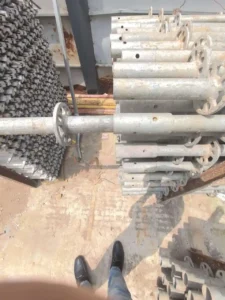
In TJJG’s current product references, a typical 48 Series example uses a sleeve-type connection, while a typical 60 Series example uses a connecting spigot.
That does not mean every 48 Series system in every market must use a sleeve or every 60 Series system must use exactly the same spigot arrangement.
Some 48 Series systems also use internal connecting spigots.
Use the connection method as supporting evidence, not as the only identification rule.
Look at the Rosette and Ledger Connection
The rosette and Ledger head are another part of the system that should be checked.
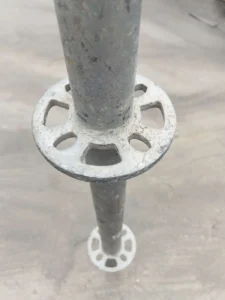
When identifying an unknown Ringlock scaffold, look at:
- rosette shape and dimensions;
- Ledger head geometry;
- wedge shape;
- how the Ledger head sits at the rosette;
- whether the wedge engages normally.
A Ledger may use a tube that looks similar to another system and still have a different connection head.
This is why system identification should include the actual node, not just the steel tube.
Check the Base Collar
The Base Collar is useful when identifying an existing Ringlock system because it sits directly in the lower starting arrangement.
Check whether its tube dimensions and connection with the Standard match the system you are trying to identify.
If a Base Collar looks similar but does not fit the Standard correctly, that is a sign that the parts may not belong to the same system.
Do not force the connection just to see whether the parts can be made to fit.
Check the Ledger Dimensions
Ledger identification needs more than one measurement.
Useful checks can include:
- tube outside diameter;
- overall Ledger length;
- Ledger head geometry;
- wedge geometry;
- actual connection with the rosette.
A similar Ledger tube does not prove that the Ledger can be transferred from one Ringlock system to another.
Check the Diagonal Brace Connection
Diagonal Braces can also help identify an existing system.
Look at:
- Brace length;
- end connection geometry;
- the intended vertical and horizontal bay dimensions;
- how the Brace connects to the Ringlock node.
Again, tube diameter by itself is not enough.
A Brace may look close to the required size and still fail to connect correctly at the node.
Check Base Jack and U-Head Jack Dimensions
Adjustable Jacks can provide more information about the component family, especially when identifying a complete existing inventory.
Depending on the system, useful checks may include:
- screw diameter;
- wall thickness;
- overall screw length;
- base plate dimensions;
- U-Head dimensions;
- nut and thread configuration;
- fit with the surrounding Ringlock components.
Do not confuse the physical Jack length with the permitted extension during site use.
For detailed Jack inspection, see Ringlock Base Jack and U-Head Jack inspection.
Photos Can Help Identify an Unknown Ringlock System
If a buyer does not know whether the existing scaffold is 48 Series or 60 Series, clear photos can save a lot of guessing.
Useful photos include:
- full Standard;
- Standard tube with a measurement reference;
- rosette close-up;
- Ledger head;
- wedge;
- Standard connection sleeve or spigot;
- Base Collar;
- Base Jack;
- Brace end connection.
A photo of a complete scaffold from twenty metres away is much less useful than a clear close-up of the connection parts.
Measurements Are Better Than Product Names
Buyers sometimes send an enquiry such as:
“We need Ringlock Ledgers.”
That still leaves the supplier with an important question:
Which Ringlock system do those Ledgers need to connect to?
If the original product specification is missing, measurements can help identify the system more reliably.
Useful information includes:
- Standard outside diameter;
- component length;
- rosette details;
- Ledger head dimensions;
- wedge details;
- Standard connection method;
- photos of the existing components.
Use the Existing Drawing or Specification If You Have It
If the original scaffold drawing, catalogue or purchase specification is still available, use it before trying to identify the system only from appearance.
The document may show:
- Standard specification;
- Ledger sizes;
- Brace sizes;
- connection type;
- component codes;
- system series;
- other product details.
This is normally more useful than guessing from a photograph alone.
Perform an Assembly Fit Check When Necessary
If the dimensions appear to match but there is still uncertainty, physically checking the mating parts can reveal problems that individual measurements miss.
A basic fit check may include:
- Standard-to-Standard connection;
- Ledger-to-rosette engagement;
- wedge locking;
- Brace connection;
- Base Collar fit;
- Base Jack fit.
A component can have a similar tube diameter and still fail at the actual connection.
For the full process, see Ringlock scaffolding assembly fit check.
Identification and Compatibility Are Not the Same Thing
Identifying a scaffold as 48 Series or 60 Series is only the first step.
It does not automatically prove that every new replacement component from another supplier will fit the existing scaffold.
Compatibility may also depend on:
- rosette geometry;
- Ledger head geometry;
- wedge design;
- Standard connection method;
- component length;
- Brace connection;
- Jack dimensions;
- actual assembly fit.
For replacement parts, see Ringlock replacement component compatibility.
Can You Identify 48 or 60 Series from Weight?
Weight can be useful as supporting product information, but it should not be the main identification method.
Component weight can change with:
- component length;
- tube dimensions;
- connection parts;
- plate dimensions;
- product design.
Measure the actual Standard diameter and check the connection details first.
Can You Identify the Series from the Application?
No.
Do not assume that 48 Series is always used for access scaffolding and 60 Series is always used for shoring.
Actual market practice and project systems vary.
The application can provide context, but it does not identify the Ringlock series by itself.
Can You Identify the Series from the Colour or Galvanizing?
No.
Surface appearance does not identify whether a Ringlock system is 48 Series or 60 Series.
Hot-dip galvanizing, surface condition or colour can tell you something about the finish, but not the system family.
Use dimensions and connection details instead.
What Information Should You Send to a Supplier?
If you need replacement components but do not know the exact Ringlock system, send as much of the following information as possible:
- photos of the existing Standard;
- Standard outside diameter;
- component lengths;
- rosette photos and measurements;
- Ledger head photos;
- wedge details;
- Standard connection photos;
- Base Collar information;
- Brace connection photos;
- existing drawing or specification, if available.
If necessary, a sample component can also be useful when visual and dimensional information is still not enough.
For replacement orders, the supplier needs more than the name “Ringlock” to reduce the risk of sending a component that looks similar but does not fit.
A Simple Identification Sequence
If the system is unknown, work through it in this order:
- Measure the Standard outside diameter.
- Check whether it points to the 48 Series or 60 Series family.
- Inspect the Standard connection method.
- Check the rosette, Ledger head and wedge.
- Check the Base Collar and Brace connections.
- Compare adjustable Jack dimensions where relevant.
- Review any existing drawing or specification.
- Perform an assembly fit check if compatibility is still uncertain.
This is more reliable than trying to identify the scaffold from one catalogue photo.
Conclusion
The quickest way to identify 48 Series and 60 Series Ringlock scaffolding is to start with the Standard outside diameter.
In TJJG’s current product data, 48 Series uses a Φ48.3 mm Standard and 60 Series uses a Φ60.3 mm Standard.
After that, check the connection details. The rosette, Ledger head, wedge, Standard connection, Base Collar, Braces and adjustable Jacks can all help confirm what system is actually in front of you.
If you are buying replacement parts, identifying “48 Series” or “60 Series” is not the end of the job. Make sure the new component also matches the existing connection and assembly.